Return on Incremental Invested Capital (ROIIC)

First, we will understand the meaning of ROIC i.e. return on invested capital. Simply put, it is nothing but the return that the business has generated on the total invested capital. It means that to date, the business has invested x amount and on that x amount, it has generated this much return.
I hope that’s clear.
So if we are getting the returns generated by the business on the capital what’s the need for ROIIC one will ask?
ROIIC helps us in finding the returns that businesses have generated on the extra capital they have invested.
ROIIC is a rough formula. We have to understand the meaning of it. Return on incremental invested capital
It’s simple to calculate ROIIC: some use earnings (or some measure of bottom-line cash flow) divided by total debt and equity. Some, like Joel Greenblatt, want to know how much tangible capital a business uses, so they define ROIC as earnings (or sometimes pretax earnings before interest payments) divided by the working capital plus net fixed assets (which is the same as adding the debt and equity and subtracting out goodwill and intangible assets). Usually, we’ll want to subtract excess cash from the capital calculation as well, as we want to know how much capital a business needs to finance its operations.
ROIC, usually only tells us the rate of return the company is generating on capital that has already been invested (sometimes many years ago). A company that produces high returns on capital is a good business, but what we want to know is how much money the company can generate going forward on future capital investments
Let’s take an example
Last year A pizza shop earned 1 crore on roughly 2 crore of investment including debt and equity.
let’s imagine we were looking this business 10 years back
We will ask 3 questions
How much cash would you produce going forward?
How much of it would we see in the form of dividends or buybacks?
Of the portion we didn’t receive, what rate of return would the company get by keeping it and reinvesting it?
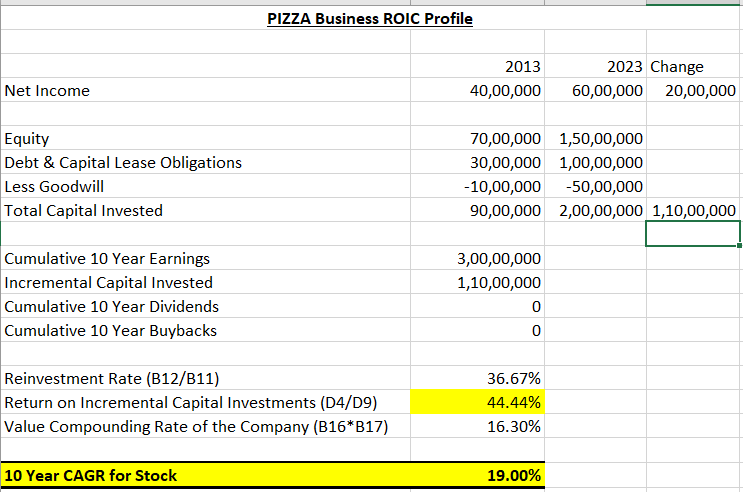
10 years ago the shop earned 40 lakh on roughly 90 lakhs of investment.
In the 10 years, the invested capital grew from 90 to 2cr and earnings from 40 lakh to 1cr.
So an incremental of 1.1 cr helped the business earn 60lakh, roughly 55%.
That is how one roughly calculated Roiic
so roughly ROIIC = Change in total capital (Debt+ Equity)—————————————————
Change in total earnings
Reinvestment Rate = Change in total capital
——————————-
net cumalative earnings
In our example, the observed change in capital over the past 10 years amounts to 1.1 crore, while the cumulative earnings for the same period total 3 crore.
Calculating the reinvestment rate, we find it to be 1.1/3 = 0.36, indicating that approximately 36% of the business's earnings are being reinvested back into its operations.
As I’ve mentioned before, a company will see its intrinsic value compound at a rate that roughly equals the product of its ROIC and its reinvestment rate (leaving aside capital allocation, which can increase or decrease value per share as well).
Intrinsic Value Compounding Rate = ROIC x Reinvestment Rate
Other factors can create higher earnings (pricing power is one big example), but this simple formula is helpful to keep in mind as a rough measure of a firm’s compounding ability.
That’s about the concept. I hope it is clear .